
Why the Left Has So Little Traction in Iran
On anti-imperialism, repression, and the Left’s distance from Iranian society

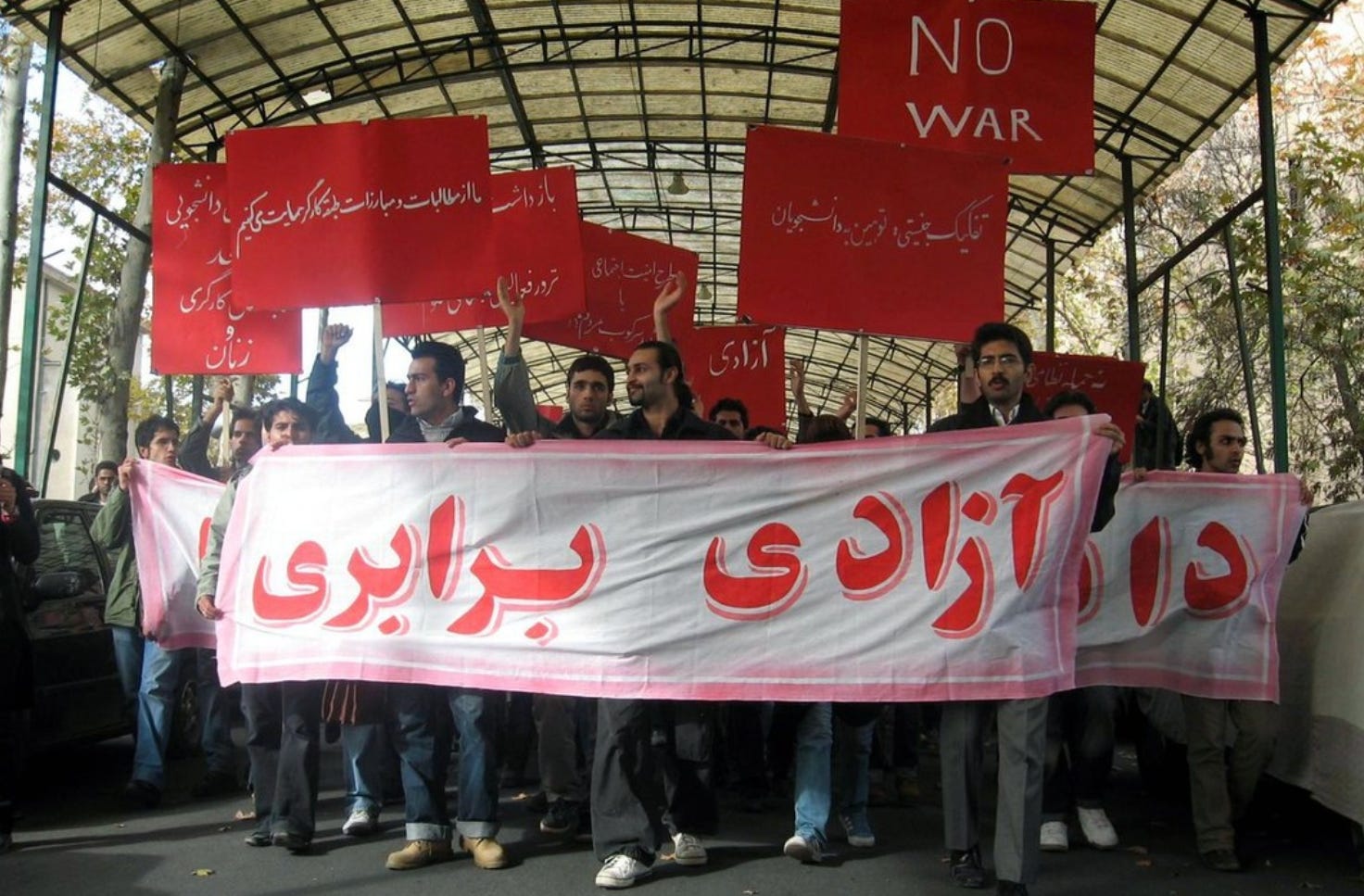
At a moment when Iran still stands near the edge of war, it may seem almost like a luxury to ask why the Left has so little traction in Iranian society. The destruction and death brought by the recent war are still unfolding: the loss of lives, jobs, infrastructure, health, and the environmental consequences of what was bombed have not yet been fully measured. That this question has to be asked while universities themselves have been bombed only makes it harder, and more necessary. But the question of what to demand of the Islamic Republic, and how to engage with society’s hopes and fears, cannot be postponed until after the crisis. Much of what society demands belongs to the terrain on which the Left should be able to speak with force: labor rights, an end to corruption, free internet access, press freedom, gender justice, an end to executions and political imprisonment, sanctions relief, and a foreign policy built around national interest. Yet none of this has made the Left more popular.
A Problem From Within
Some background may help. During Ahmadinejad’s first presidency, from 2005 to 2009, a younger generation on Iranian campuses helped shape what became known as the younger-generation Left. This was decades after the Islamic Republic’s mass executions of leftists in the late 1980s. The new campus Left emerged from reform-era openings around women’s rights, student organizing, and labor unrest, and from reformism’s failure to give those struggles a more radical language. As Peyman Vahabzadeh shows, one of its most visible formations was Students for Freedom and Equality, or Daneshjuyan-e Azadikhah va Barabaritalab, a loose leftist student network that brought questions of social justice back into campus politics and faced a wave of arrests in December 2007. It opened a cross-generational dialogue with survivors of that earlier destruction, recovering what remained of an older language and building something new from it. For many on campus at the time, that language made it possible to think repression, inequality, and historical violence together.
In my own experience, the communities formed in those years—and again after the 2009 Green Movement—kept thinning at each major political juncture. Each new wave of protest produced the same argument: weakening the state during a moment of external threat, some said, only played into the empire’s hands. For some, anti-imperialism took priority over criticizing the state’s own repression—a shift often described, in recent years, as becoming mehvar-e moqāvematī, aligned with the Axis of Resistance. Some others shared the same unease but stayed quiet, afraid that challenging their anti-imperialist friends would mark them, inside the Left itself, as no longer properly of the Left. Over time, these disagreements created distance. Some collaborations fell apart, and conversations that had once felt shared became less frequent. Looking back, I can see how much of what I wrote in those years and afterward came out of these arguments. During the November 2019 uprising, I wrote “The Silenced Screams Fighting Impoverishment in Iran” and “Anti-Imperialism as an Intellectual Trap.” The critique was already there: instead of listening to people risking their lives in the streets, parts of the Left chose a politics that already knew, from elsewhere, what those people were supposed to want.
That rupture has only widened. During the January 2026 protests, after demonstrations had already begun, Reza Pahlavi, the exiled son of Iran’s last shah, called on people to take to the streets and his name appeared in protesters’ slogans; many on the Left did not know how to respond. Some stayed silent; others quickly dismissed the protests outright, less as an evidence-based analysis than as anger that the street had not spoken in the language the Left expected. At the same time, much of Iranian society has come to view the Left with suspicion.
Over the past decade, as inequality, poverty, corruption, and repression have deepened, the Left has become, in some quarters, an object of contempt close to the contempt directed at the Islamic Republic itself. What explains this?
The Wrong Explanation
An easy explanation would blame this entirely on monarchist media, which has become a common explanation for many shifts in Iranian public opinion. I do not think that explanation holds up. Propaganda exists against every political tendency; the Islamic Republic itself has spent decades vilifying its historical other, the Pahlavi monarchy. If propaganda alone explained political desire, monarchism would not have gained the traction it has. To say society has been manipulated is another version of the old false-consciousness argument: it names a political behavior without explaining it. Monarchist media’s repeated charge against the Left—that parts of the Left helped give intellectual legitimacy to the 1979 Revolution as an emancipatory project, and that parts of the Left still look for liberation in the Islamic Republic’s own language of resistance—has some force, but it also flattens a contingent history into one linear story of complicity. The question is why that flattened story has become persuasive—and what in the Left’s own language has helped make it so.
The more anti-imperialist Left often works from a fixed set of concepts—imperialism, capitalism, class struggle—that become positions to defend rather than tools for understanding society. Evidence is either dismissed as the behavior of a desperate, manipulated population or fitted into what the Left already believes liberation should mean. But the problem is not confined to this faction. Even parts of Iran’s Left that are more sympathetic to the streets often speak in a vocabulary translated from Western Marxism and critical theory—a path to the universal, even if a European one, and a defense against the nativist, anti-Western currents that shaped the post-1979 state. That inheritance, however, has left parts of the Left more fluent in theory than in the social world it claims to explain. One sign of this distance is what it treats with suspicion: individual liberty, joining the world’s economic order, and a foreign policy built on national interest. These demands are often dismissed as liberal, pro-capitalist, nationalist, or insufficiently materialist. The result is a Left waiting for society to become worthy of its concepts, rather than letting society’s experience reshape them.
There have been serious efforts to move beyond this mode of translation-based knowledge production. Among others, Mohammad Maljoo’s writing has long shaped public discussion, and Parviz Sedaghat’s website Naqd-e Eqtesad-e Siyasi has sustained important debates through a substantial body of analysis, even if much of it remains dense enough to challenge well-trained readers. But the larger task remains unfinished. Inside Iran, this cannot be separated from censorship, surveillance, and repression: Sedaghat himself was arrested in November 2025, and Maljoo was reportedly summoned, as part of a broader wave of pressure on researchers and writers connected to critical and left intellectual circles.
Thinking With the Debate
The recent debate on Iran’s Left and anti-imperialism offers a way to think through this problem with others who have approached it from within the Left itself.
In October 2025, a few months after the twelve-day war, Mohammad Maljoo distinguished between two lefts. The Axis-of-Resistance Left treats anti-imperialism as the master lens and, in moments of war and ceasefire, tends to align with the state’s logic of confrontation. The democratic or people-oriented Left, by contrast, seeks to oppose both foreign domination and domestic authoritarianism, defending society without turning that defense into support for the state. But even in Maljoo’s account, this second Left is still building the language and force that would allow it to oppose both forms of domination in practice. It remains, in this sense, unfinished.
Kianoush Boustani and Yashar Darolshafa help explain why the Axis-of-Resistance Left has been so difficult to dislodge. Boustani shows how geopolitics crowds out the social question: class struggle and domestic repression become secondary to confrontation with the United States. Imperialism is treated less as a global system of power than as a single enemy, usually the United States, and any domestic movement that potentially weakens the Iranian state can then be treated as a possible instrument of that enemy. Darolshafa published his own account of this distortion on May 31, 2026; he was arrested in Tehran the following day, and, as Naghmeh Sohrabi notes, his whereabouts remained unknown at the time of her writing. [1] His essay, later introduced and translated in shortened form by Sohrabi, traces the “people–imperialism contradiction” to the 1970s, when it functioned as a practical organizing framework against a dependent capitalist dictatorship, without abandoning class analysis. Sohrabi’s introduction frames the debate Darolshafa is intervening in by quoting both Maljoo and Ghamari-Tabrizi. According to Darolshafa, the Islamic Republic could present itself after 1979 in a language of anti-imperialism and solidarity with the oppressed, and some on the Left mistook that rhetoric for a material political position. In “The Cold That Stays,” I argue that nationalists, leftists, and Islamist currents could recognize one another as part of the same struggle against a shared enemy—the United States, tied to the Shah and the memory of the 1953 coup—but they meant different things by liberation, sovereignty, and justice. In Darolshafa’s account, the state absorbed this ambiguous anti-imperialist language, and once it was detached from concrete conditions, what had been a revolutionary formulation for the Left became a way of legitimizing an existing capitalist, repressive state.
If Boustani and Darolshafa clarify the internal logic of the Axis-of-Resistance Left, Behrooz Ghamari-Tabrizi’s careful and wide-ranging essay challenges the very distinction on which Maljoo’s account depends. His intervention is valuable because it makes the strongest version of the case against Maljoo’s distinction: that imperialism and domestic authoritarianism are not separable realities, but historically intertwined. In peacetime, this insight might seem to cut both ways: if the two reproduce each other, one could oppose domestic repression as forcefully as imperialism, without having to choose between them. But the symmetry breaks down once we ask what role this account assigns to Iran’s state. If the state is treated as the force actually opposing imperialism, and imperialism is understood as inseparable from domestic repression, then the state’s anti-imperialism begins to appear as the terrain through which repression must be addressed, rather than as one of the ways repression is organized. Taken to its logical end, this changes who counts as the subject of liberation: those who defend the state, at least in its “resistance” against imperialism, appear as the agents of emancipation, while those imprisoned for resisting it are pushed to the margins of the anti-imperialist cause.
This tension appears most clearly in Ghamari-Tabrizi’s own examples, especially his reading of the truckers’ strike before the June 2025 twelve-day war, organized around material grievances. Ghamari-Tabrizi asks whether the union should have continued the strike under Israeli attack, even though its demands were just and its methods peaceful. The question is rhetorical, and its implied answer is no—though by then the state had already weakened the strike through arrests and repression, before the war even began. In that moment, this logic treats the truckers’ repression and the permanent threat of war as two separate problems—one to be criticized, one to be defended—when both are tied to the state’s own policies. Repression and geopolitical crisis both belong to the state’s mode of rule.
Toward the end, Ghamari-Tabrizi’s essay asks how the state might be made accountable to society—a demand worth taking seriously. I share that concern, but would approach his closing claim more cautiously. He argues that the Islamic Republic regained confidence through the battlefield and diplomacy, and that the nation did not leave it alone during the war. Under internet shutdowns, fear of arrest, and a controlled media environment, however, it was difficult to know what society thought beyond what state media allowed to be seen. Arrests and executions of political prisoners continued throughout the war, only weeks after the January protests and the crackdown that followed. The problem is larger than this case: anti-imperialist analysis risks mistaking a managed image of unity for evidence of public feeling, widening the distance between intellectual analysis and broader society.
What appears as a theory of inseparability of imperialism and domestic repression becomes, in practice, an imperialism-first politics. This same imperialism-first logic has been challenged from another angle by Darolshafa, who argues that the state is not outside the order it claims to oppose, but part of the same capitalist order imperialism sustains. My own response starts from lived experience: many Iranians do not experience the state’s anti-imperialism and its repression as two separable things, whatever the theory claims.
What People Actually Live
For some on the Left, imperialism and domestic repression are inseparable because imperialism is seen as the force that produces or intensifies authoritarianism. For many Iranians, however, the problem appears in a different form: the state’s anti-imperialism is one of the main languages through which authoritarianism is defended. The state arrests protesters and dissidents—and, in some cases, executes them—by labeling them agents of empire, infiltrators, or forces weakening the country against external enemies. It explains corruption, deprivation, and the widening gap between rich and poor as the unavoidable cost of resistance, even though sanctions and isolation are tied to policies society never chose. This is why many Iranians do not experience normalization with the United States as capitulation to empire. They experience it, rather, as a way to take one of the state’s most effective weapons out of its hands: the language of permanent emergency through which democratic demands become foreign infiltration and economic strangulation becomes the price of resistance. I develop this argument at greater length in “The Cold That Stays: The 1953 Coup and Its Afterlife in Iranian Political Memory.”
The demand is not to welcome American power, but to hold the state to a standard of national interest: to spend public resources on citizens’ lives rather than confrontation, and to answer for the conditions under which people live. The point is not that the world order is just. It is that many Iranians do not want to pay the price for a state project that claims to challenge that order while failing to protect its own citizens’ lives, rights, and national interest. One state-linked poll captured part of this gap: 56 percent of respondents prioritized sanctions relief in negotiations with the United States, while only 5 percent prioritized recognition of the country’s claimed nuclear rights. Dependency on Russia and China, too, does not look like anti-imperialism to many people; it looks like another form of subordination, one more sign that Iranians remain cut off from the ordinary networks through which much of the world lives—unable even to use international credit cards, make simple online purchases, or book travel with the ease others take for granted. Wanting normal relations with the United States is, for many Iranians, a demand for normal life. None of this means that global inequality, or the domination of the United States and its allies, has not been experienced by Iranians as destruction and death. But in Iran’s case, the concept of imperialism has become so entangled with the state’s own struggle for power that it is now nearly impossible to use it to see the world clearly. Normalization, in this sense, is not a retreat from that larger critique. It may be the precondition for being able to make it again—in a language no longer trapped between the state’s rhetoric of resistance and the fantasy that outside force will bring rescue. Such a language remains to be built.
Iranian state officials defend the country’s regional policy by arguing that when its allies and proxies were strong, war stayed outside Iran’s borders, and that once they weakened, Iran itself became exposed. But this treats the state’s wars as laws of nature, not political choices. The Islamic Republic is not a resistance movement that happens to govern badly at home. It is a state, and its policies must be judged by the standards citizens use to judge any state: national interest, public consent, development, welfare, accountability, and protection of life. A significant part of the Left has shown sympathy for the state’s own account of these policies, treating them as necessary defenses against imperial aggression. Here the distance between that Left and much of Iranian society becomes especially sharp. Many Iranians do not accept that their country had to pursue its conflicts through Syria, Lebanon, Iraq, or Yemen, or that the destruction brought to Arab societies can be justified as the price of Iran’s security. They also see these policies as a waste of national resources in a country marked by poverty, corruption, collapsing infrastructure, and blocked development. Nor can the Islamic Republic pose as leader of regional resistance while its own Arab, Baloch, and Kurdish citizens remain deprived of their rights at home. Boustani and Darolshafa both read this posture for what it is: not resistance, but a struggle for a larger share of power in the region. A democratic politics in Iran would have to reject both the state’s self-justifying language of “forward defense” and the indifference it produces toward Arab lives. Real solidarity with the Arab world cannot mean defending the Islamic Republic’s regional project. It has to begin with recognizing the destruction that project has produced inside Iran and across the Arab world, including the way it has corrupted resistance movements that might otherwise have carried more progressive possibilities.
A Different Left?
Returning to where this essay began: why has the Left failed to become a credible language for these grievances? My sense is that the answer lies in this gap: across its democratic and anti-imperialist currents, the Left continues to speak as if anti-imperialism and democratization are two principles to be balanced, while many Iranians experience the Islamic Republic’s anti-imperialism as one of the main ways democratization, development, and ordinary social life have been blocked. People live with the material consequences of state policy. They demand ordinary government, not permanent mobilization. It is their experience—not the Left’s inherited frameworks—that should revise the Left’s concepts as political life unfolds, not only after movements have already been misread or crushed.
This is also why analysis that turns lived experience into a caricature is so damaging. Treating women’s defiance of mandatory hijab as evidence that the state has already conceded the question, despite continued arrests and violence against women over hijab, or explaining the January protests almost entirely through sanctions and geopolitics while leaving out the state’s accumulated failures—corruption, repression, and the costs of the nuclear program and regional policies that have delivered nothing to ordinary Iranians—misses the point. So does reducing protesters to violence and anger, or claiming that the protests lacked any underlying infrastructure. The claim that no organizing infrastructure existed reflects what is visible to an analysis insufficiently informed by Iran’s underground networks of labor, student, and women’s organizing, as well as the neighborhood-based networks through which protests have often taken shape. The same reduction appears when commentators take up Trump’s claim about weapons, alter both its timing and content, and then accuse protesters of armed struggle without evidence and against the documented findings of human rights organizations. In each case, lived experience is not being analyzed on its own terms; it is being adjusted to fit a position already taken.
The point is that the Left needs to engage more deeply with the social realities it claims to understand. That would mean a different kind of Left: one that produces political thought out of its encounter with society, rather than importing theory and imposing it from outside, or mistaking the accumulation of “right” positions for political understanding. A Left that wants to be a real force cannot wait for the perfectly articulated movement to arrive; that kind of waiting leaves it in history’s waiting room, letting the urgency of each moment burn away. It has to be shaped by movements that shout names it does not want to hear, or does not yet know how to hear—whether Mir-Hossein Mousavi or Reza Pahlavi. The task is to learn what those names mean, not to wait until they change.
That work has to happen in the language people actually use, not the one the Left is waiting for them to adopt. The Left, too, would have to let itself be unsettled and drawn in directions it cannot fully predict. Without that risk, it remains beside the movements it hopes to understand, speaking about them in a language that no longer hears their rhythm.
[1]: Darolshafa’s imprisonment is not new. He had previously been arrested, tried, and sentenced to prison several times since 2009, and earlier imprisonment left him with physical injuries requiring treatment. A video published by Manjanigh from one of his earlier imprisonments shows him singing. He is also a musician, in addition to being a researcher and writer; another video shows him playing with other musicians.